

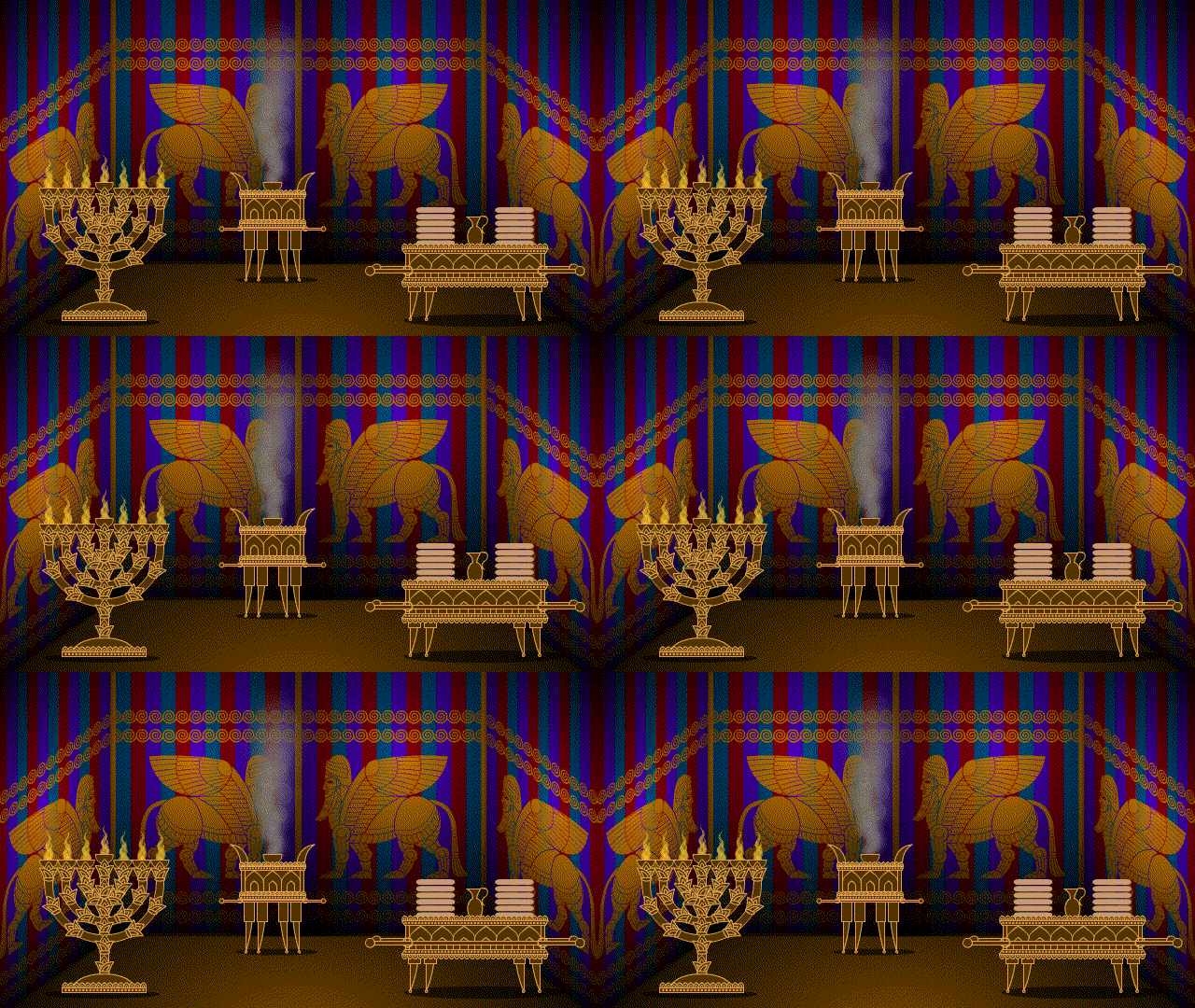
When you pass through the outer courts, you enter the Holy Place. Inside, you will find three pieces of furniture: the lampstand, the table of showbread, and the altar of incense. We see that each element in the Holy Place is about bringing forth the spoken Word of God, and thus, the Holy Place represents the conscious soul because the Tabernacle represents Jesus Christ Who also anointed believers with the Holy Spirit to be the temples of God.
1. The lampstand
Exodus 25:31-32
31 And thou shalt make a candlestick of pure gold: of beaten work shall the candlestick be made: his shaft, and his branches, his bowls, his knops, and his flowers, shall be of the same.
32 And six branches shall come out of the sides of it; three branches of the candlestick out of the one side, and three branches of the candlestick out of the other side:
The lampstand serves as a practical piece of household furniture, particularly in areas devoid of windows. The tabernacle had no windows, symbolizing the darkness of the world in which we reside. The candlestick, placed in the holy place, provided the sole source of light. Thus, the lampstand symbolizes the Church of God, the singular source of light on Earth. This light goes out as the Word of God to illuminate people on the divine nature of God and His righteousness so that we can follow Him in obedience through faith.
Revelation 1:20
The mystery of the seven stars which thou sawest in my right hand, and the seven golden candlesticks. The seven stars are the angels of the seven churches: and the seven candlesticks which thou sawest are the seven churches.
The church serves as God’s lampstand to enlighten this darkened world about the truth to see the light of life in Jesus Christ. Christians are summoned to be the world’s light and not hide the truth or be ashamed of the truth. The metaphor of light represents knowledge of God’s truth and glory, bringing life, and darkness represents ignorance of God’s truth and glory, bringing confusion. Therefore, Jesus is the world’s light and passed that onto all Christians through His disciples/apostles to the rest of the world. This implies that Christians ought to live in a manner that allows their light to be seen, making it evident that they are followers of Christ.
John 8:12
Then spake Jesus again unto them, saying, I am the light of the world: he that followeth me shall not walk in darkness, but shall have the light of life.
Matthew 5:14-16
14 Ye are the light of the world. A city that is set on an hill cannot be hid.
15 Neither do men light a candle, and put it under a bushel, but on a candlestick; and it giveth light unto all that are in the house.
16 Let your light so shine before men, that they may see your good works, and glorify your Father which is in heaven.
Are the people at your workplace aware that you’re a Christian? If not, it might mean your light is concealed from them and needs to shine forth.
How can we keep shining brightly for the Lord?
The oil in the lampstand’s cups must be replenished to keep the flame alive symbolizing that we require the Holy Spirit’s anointing to keep shining for the Lord.
Invite the Holy Spirit to transform our lives and endow us with His oil, so that we may serve as a potent beacon in the world.
2. Table of shewbread
The table, made from acacia wood, was two cubits long, one cubit wide, and one and a half cubits tall. It was covered with pure gold and had gold moulding around it. On this table lay the Bread of the Presence, which was always set before God. Twelve loaves were placed on it, representing God’s provision for the twelve tribes of Israel. Known also as the Showbread, it symbolized God’s continual sustenance and the significance of remaining in God’s presence. The bread was sacred, offered to God, and only the priests could eat it. Every Sabbath, they ate the old bread and placed new loaves and frankincense, provided by the people, on the table.
The table of showbread stood as a perpetual symbol of God’s unending covenant and his care for the twelve tribes of Israel, depicted by the twelve loaves.
Exo 25:23-30
23 Thou shalt also make a table of shittim wood: two cubits shall be the length thereof, and a cubit the breadth thereof, and a cubit and a half the height thereof.
24 And thou shalt overlay it with pure gold, and make thereto a crown of gold round about.
25 And thou shalt make unto it a border of an hand breadth round about, and thou shalt make a golden crown to the border thereof round about.
26 And thou shalt make for it four rings of gold, and put the rings in the four corners that are on the four feet thereof.
27 Over against the border shall the rings be for places of the staves to bear the table.
28 And thou shalt make the staves of shittim wood, and overlay them with gold, that the table may be borne with them.
29 And thou shalt make the dishes thereof, and spoons thereof, and covers thereof, and bowls thereof, to cover withal: of pure gold shalt thou make them.
30 And thou shalt set upon the table shewbread before me alway.
Today, Christians partake in communion, consuming consecrated bread in memory of Jesus Christ’s sacrifice on the cross. The showbread table in Israel’s worship foreshadowed the coming Messiah and his covenant fulfilment. Modern communion practices serve as a retrospective commemoration of Christ’s triumph over death on the cross.
John 6:35
And Jesus said unto them, I am the bread of life: he that cometh to me shall never hunger; and he that believeth on me shall never thirst.
Besides provision, the bread represented the Word of God confirmed by Jesus when He quoted from Deuteronomy 8:3 that He lives not only by bread alone but also by the Word of God. It is living by the Word based on His grace and mercy that gives us life and rest, not the Sabbath.
Deuteronomy 8:3
And he humbled thee, and suffered thee to hunger, and fed thee with manna, which thou knewest not, neither did thy fathers know; that he might make thee know that man doth not live by bread only, but by every word that proceedeth out of the mouth of the LORD doth man live.
Matthew 4:4
But he answered and said, It is written, Man shall not live by bread alone, but by every word that proceedeth out of the mouth of God.
Matthew 11:28
Come unto me, all ye that labour and are heavy laden, and I will give you rest.
As believers under this new and better covenant, our sins are forgiven and paid for by Jesus. There is no longer a need to offer sacrifices. Our daily provision is now the living Word of God.
Hebrews 8:6
But now hath he obtained a more excellent ministry, by how much also he is the mediator of a better covenant, which was established upon better promises.
3. Altar of golden incense
Exodus 30:1-3
1 And thou shalt make an altar to burn incense upon: of shittim wood shalt thou make it.
2 A cubit shall be the length thereof, and a cubit the breadth thereof; foursquare shall it be: and two cubits shall be the height thereof: the horns thereof shall be of the same.
3 And thou shalt overlay it with pure gold, the top thereof, and the sides thereof round about, and the horns thereof; and thou shalt make unto it a crown of gold round about.
David prayed to God knowing that his prayer was like incense and lifted hands as an evening sacrifice.
Psalm 141:1-2
1 (A Psalm of David.) LORD, I cry unto thee: make haste unto me; give ear unto my voice, when I cry unto thee.
2 Let my prayer be set forth before thee as incense; and the lifting up of my hands as the evening sacrifice.
The prayers in the Tabernacle from the saints are represented by the altar of incense which goes up to God.
Revelation 5:8
And when he had taken the book, the four beasts and four and twenty elders fell down before the Lamb, having every one of them harps, and golden vials full of odours, which are the prayers of saints.
The presence of the incense table in the Tabernacle appears to underscore a clear message: reaching God’s presence is through prayer. However, some erroneously believe that they draw near to God simply by leading a virtuous life or by attending church. The burning of incense at the altar of incense also implies that we must die to self-will to approach God.