

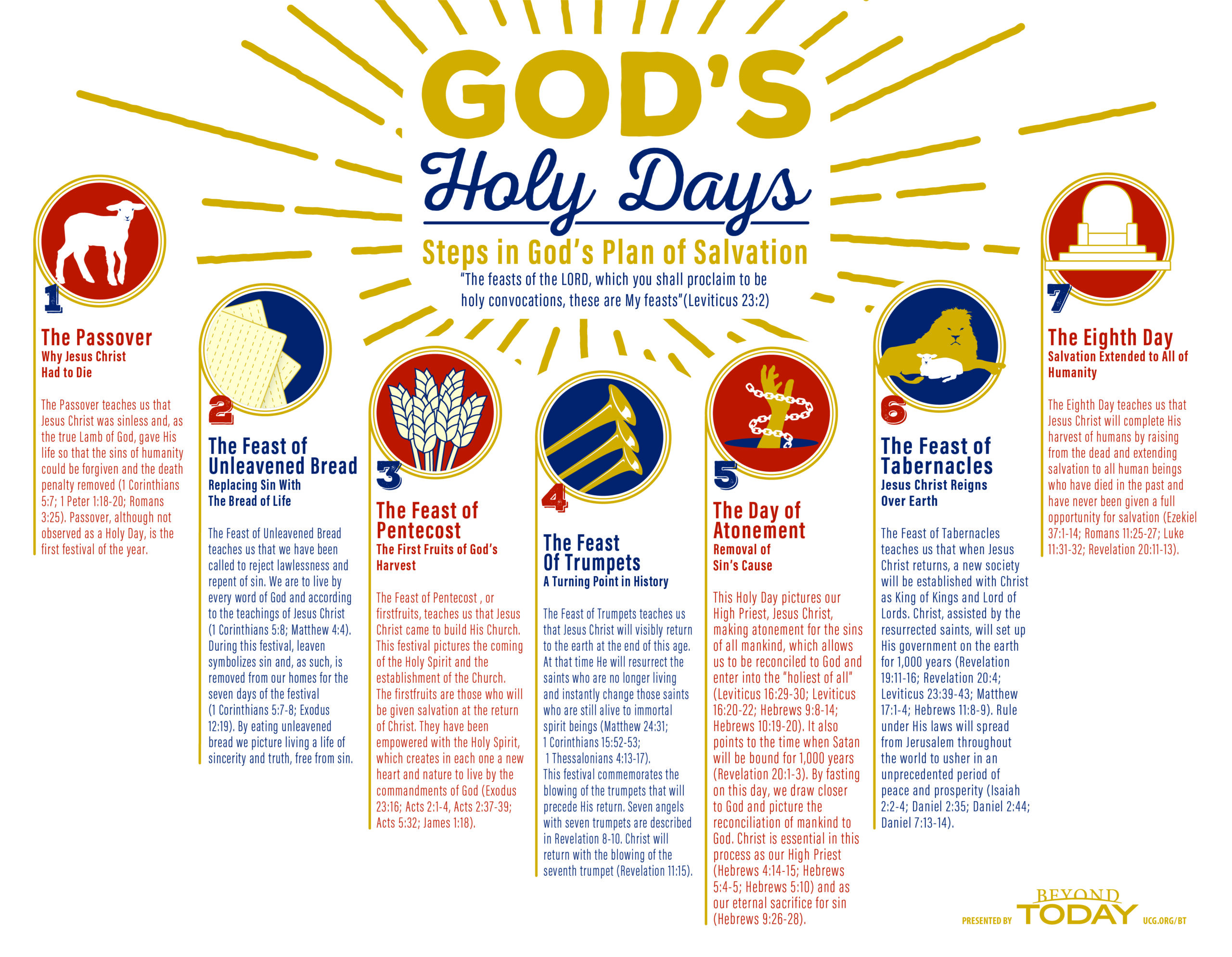
The feasts, like other Old Testament hidden truths, give us a better understanding of God and His ways in Christ, and God’s love for humanity.
1. Passover
In the Old Testament, the Passover feast is about Israel’s children being protected from the angel of death by the last plague when he passed over those who applied the blood of the lamb to their doors. The plague was to kill every firstborn of Egypt’s children and animals which would see Pharoah allow Israel to leave their country to worship God. The Israelites took a bundle of hyssop and dipped it into the blood in the basin at the threshold. Going up, they put it up on the lintel, then touched the two sides of the frame (Exodus 12), their movements forming a cross.
Leviticus 23:4-8
4 These are the feasts of the LORD, even holy convocations, which ye shall proclaim in their seasons.
5 In the fourteenth day of the first month at even is the LORD’S passover.
6 And on the fifteenth day of the same month is the feast of unleavened bread unto the LORD: seven days ye must eat unleavened bread.
7 In the first day ye shall have an holy convocation: ye shall do no servile work therein.
8 But ye shall offer an offering made by fire unto the LORD seven days: in the seventh day is an holy convocation: ye shall do no servile work therein.
In the New Testament Jesus is our Passover who takes away the sins of the world and gives life, as spoken by John the Baptist. Jesus was the lamb that was slain as the last sacrifice for humanity for all time. His death allows the judgment we deserve to pass over us.
When we accept Christ, we accept reconciliation with God because of his death on the cross, and through faith, we are justified as righteous.
The next day John seeth Jesus coming unto him, and saith, Behold the Lamb of God, which taketh away the sin of the world.
2. Unleavened Bread
The seven-day feast starts the day after Passover begins; during this time, the Jews ate unleavened bread as they had to depart Egypt hastily and could not wait for their bread to rise. It serves as a period to remember the difficulties faced in Egypt and celebrate the liberation God provided from bondage.
In the Bible, leaven is frequently symbolic of sin and corruption. Once yeast is mixed in, it becomes a permanent element of the bread, paralleling the pervasive influence of sin in human life. The Jews regularly offered sacrifices of unblemished animals as a temporary expiation for sin. However, only the Messiah, the ultimate unblemished sacrifice, could provide a lasting atonement.
Leviticus 23:6
And on the fifteenth day of the same month is the feast of unleavened bread unto the LORD: seven days ye must eat unleavened bread.
The unleavened bread symbolizes Jesus’ sinless existence; he stands as the sole flawless offering for our transgressions. Jesus proclaims with certainty that he is the bread of life. He does more than erase our sins; he sustains our souls.
John 6:35
And Jesus said unto them, I am the bread of life: he that cometh to me shall never hunger; and he that believeth on me shall never thirst.
3. First Fruits
The Feast of First Fruits is one of the three Jewish harvest festivals to give thanks and honour to God for His provisions. Unbeknownst to them at the time, the children of Israel were commemorating what would be a significant day in history.
The Passover lambs were sacrificed by the priests on the 14th day of Nisan, and the first day of Passover fell on the 15th. The Feast of First Fruits was observed on the third day, the 16th of Nisan, coinciding with the day Jesus was resurrected from the dead.
Leviticus 23:10
Speak unto the children of Israel, and say unto them, When ye be come into the land which I give unto you, and shall reap the harvest thereof, then ye shall bring a sheaf of the firstfruits of your harvest unto the priest:
Paul describes Jesus as the ‘first fruits’ of those who have died. He signifies the beginning of a significant harvest of souls — encompassing everyone — who will be resurrected to eternal life through the new covenant established by his sacrifice.
1 Corinthians 15:20
But now is Christ risen from the dead, and become the firstfruits of them that slept.
Luke 22:20
Likewise also the cup after supper, saying, This cup is the new testament in my blood, which is shed for you.
4. Feast of Weeks or Pentecost
This festival marks the second of three harvest celebrations. Occurring exactly seven weeks after the Feast of First Fruits, it is also referred to as Pentecost, meaning “fifty days.” Traditionally, it involved presenting the first grain harvest and two leavened loaves of bread to the Lord as an offering.
Leviticus 23:16
Even unto the morrow after the seventh sabbath shall ye number fifty days; and ye shall offer a new meat offering unto the LORD.
God’s plan for salvation extended beyond the Jewish people. This plan was unveiled through Jesus, who informed his disciples that “the harvest is plentiful, but the labourers are few.” He then set the plan in motion, instructing them to stay in Jerusalem and await the Holy Spirit.
Matthew 9:37
Then saith he unto his disciples, The harvest truly is plenteous, but the labourers are few;
Acts 1:4
And, being assembled together with them, commanded them that they should not depart from Jerusalem, but wait for the promise of the Father, which, saith he, ye have heard of me.
The arrival marked the birth of the Church on Pentecost, initiating the harvest with 3,000 souls. The message expanded to include both Jews and Gentiles (symbolized by the two leavened loaves of bread), thereby extending the harvest to us.
5. Feast of Trumpets
In a solemn declaration, God instructs His people to rest. Throughout this period, all customary work is forbidden, and both men and women are to present a food offering to God. God orders His people to assemble and celebrate the edict with blasts of trumpets.
Leviticus 23:24
Speak unto the children of Israel, saying, In the seventh month, in the first day of the month, shall ye have a sabbath, a memorial of blowing of trumpets, an holy convocation.
On the same front, the sound of a trumpet is also associated with the rapture, or the time Jesus will return for his bride. Once he returns, there will be a wedding feast of celebration. says, “Blessed are those who are invited to the wedding feast of the Lamb”. He’s preparing us to celebrate!
Revelation 19:9
And he saith unto me, Write, Blessed are they which are called unto the marriage supper of the Lamb. And he saith unto me, These are the true sayings of God.
1 Corinthians 15:52
In a moment, in the twinkling of an eye, at the last trump: for the trumpet shall sound, and the dead shall be raised incorruptible, and we shall be changed.
6. Day of Atonement
To make “atonement” means to provide restitution for wrongs done. It was a day for humility and repentance before God, a time for Jews to align their hearts, consciences, and lives with Him. The ritual included animal sacrifices as the High Priest entered the Holy of Holies. The actions of the High Priest could only serve as an annual remittance for their sins. Yet, concealed within this practice was the promise of one who would offer permanent atonement for their sins.
In the sacrificial rituals, the bull and one of the goats served as offerings of gratitude, while the “scapegoat” embodied the sins of the people. This scapegoat was laden with all of Israel’s transgressions and dispatched into the wilderness.
Leviticus 16
1 And the LORD spake unto Moses after the death of the two sons of Aaron, when they offered before the LORD, and died;
2 And the LORD said unto Moses, Speak unto Aaron thy brother, that he come not at all times into the holy place within the vail before the mercy seat, which is upon the ark; that he die not: for I will appear in the cloud upon the mercy seat.
3 Thus shall Aaron come into the holy place: with a young bullock for a sin offering, and a ram for a burnt offering.
4 He shall put on the holy linen coat, and he shall have the linen breeches upon his flesh, and shall be girded with a linen girdle, and with the linen mitre shall he be attired: these are holy garments; therefore shall he wash his flesh in water, and so put them on.
5 And he shall take of the congregation of the children of Israel two kids of the goats for a sin offering, and one ram for a burnt offering.
6 And Aaron shall offer his bullock of the sin offering, which is for himself, and make an atonement for himself, and for his house.
7 And he shall take the two goats, and present them before the LORD at the door of the tabernacle of the congregation.
8 And Aaron shall cast lots upon the two goats; one lot for the LORD, and the other lot for the scapegoat.
9 And Aaron shall bring the goat upon which the LORD’S lot fell, and offer him for a sin offering.
10 But the goat, on which the lot fell to be the scapegoat, shall be presented alive before the LORD, to make an atonement with him, and to let him go for a scapegoat into the wilderness.
11 And Aaron shall bring the bullock of the sin offering, which is for himself, and shall make an atonement for himself, and for his house, and shall kill the bullock of the sin offering which is for himself:
12 And he shall take a censer full of burning coals of fire from off the altar before the LORD, and his hands full of sweet incense beaten small, and bring it within the vail:
13 And he shall put the incense upon the fire before the LORD, that the cloud of the incense may cover the mercy seat that is upon the testimony, that he die not:
14 And he shall take of the blood of the bullock, and sprinkle it with his finger upon the mercy seat eastward; and before the mercy seat shall he sprinkle of the blood with his finger seven times.
15 Then shall he kill the goat of the sin offering, that is for the people, and bring his blood within the vail, and do with that blood as he did with the blood of the bullock, and sprinkle it upon the mercy seat, and before the mercy seat:
16 And he shall make an atonement for the holy place, because of the uncleanness of the children of Israel, and because of their transgressions in all their sins: and so shall he do for the tabernacle of the congregation, that remaineth among them in the midst of their uncleanness.
17 And there shall be no man in the tabernacle of the congregation when he goeth in to make an atonement in the holy place, until he come out, and have made an atonement for himself, and for his household, and for all the congregation of Israel.
18 And he shall go out unto the altar that is before the LORD, and make an atonement for it; and shall take of the blood of the bullock, and of the blood of the goat, and put it upon the horns of the altar round about.
19 And he shall sprinkle of the blood upon it with his finger seven times, and cleanse it, and hallow it from the uncleanness of the children of Israel.
20 And when he hath made an end of reconciling the holy place, and the tabernacle of the congregation, and the altar, he shall bring the live goat:
21 And Aaron shall lay both his hands upon the head of the live goat, and confess over him all the iniquities of the children of Israel, and all their transgressions in all their sins, putting them upon the head of the goat, and shall send him away by the hand of a fit man into the wilderness:
22 And the goat shall bear upon him all their iniquities unto a land not inhabited: and he shall let go the goat in the wilderness.
23 And Aaron shall come into the tabernacle of the congregation, and shall put off the linen garments, which he put on when he went into the holy place, and shall leave them there:
24 And he shall wash his flesh with water in the holy place, and put on his garments, and come forth, and offer his burnt offering, and the burnt offering of the people, and make an atonement for himself, and for the people.
25 And the fat of the sin offering shall he burn upon the altar.
26 And he that let go the goat for the scapegoat shall wash his clothes, and bathe his flesh in water, and afterward come into the camp.
27 And the bullock for the sin offering, and the goat for the sin offering, whose blood was brought in to make atonement in the holy place, shall one carry forth without the camp; and they shall burn in the fire their skins, and their flesh, and their dung.
28 And he that burneth them shall wash his clothes, and bathe his flesh in water, and afterward he shall come into the camp.
29 And this shall be a statute for ever unto you: that in the seventh month, on the tenth day of the month, ye shall afflict your souls, and do no work at all, whether it be one of your own country, or a stranger that sojourneth among you:
30 For on that day shall the priest make an atonement for you, to cleanse you, that ye may be clean from all your sins before the LORD.
31 It shall be a sabbath of rest unto you, and ye shall afflict your souls, by a statute for ever.
32 And the priest, whom he shall anoint, and whom he shall consecrate to minister in the priest’s office in his father’s stead, shall make the atonement, and shall put on the linen clothes, even the holy garments:
33 And he shall make an atonement for the holy sanctuary, and he shall make an atonement for the tabernacle of the congregation, and for the altar, and he shall make an atonement for the priests, and for all the people of the congregation.
34 And this shall be an everlasting statute unto you, to make an atonement for the children of Israel for all their sins once a year. And he did as the LORD commanded Moses.
Leviticus 23:26-32
26 And the LORD spake unto Moses, saying,
27 Also on the tenth day of this seventh month there shall be a day of atonement: it shall be an holy convocation unto you; and ye shall afflict your souls, and offer an offering made by fire unto the LORD.
28 And ye shall do no work in that same day: for it is a day of atonement, to make an atonement for you before the LORD your God.
29 For whatsoever soul it be that shall not be afflicted in that same day, he shall be cut off from among his people.
30 And whatsoever soul it be that doeth any work in that same day, the same soul will I destroy from among his people.
31 Ye shall do no manner of work: it shall be a statute for ever throughout your generations in all your dwellings.
32 It shall be unto you a sabbath of rest, and ye shall afflict your souls: in the ninth day of the month at even, from even unto even, shall ye celebrate your sabbath.
Hebrews 9:12
Neither by the blood of goats and calves, but by his own blood he entered in once into the holy place, having obtained eternal redemption for us.
The Jewish authorities condemned Jesus, and he, bearing the sins of humanity, was taken outside the city to be crucified. “He is the offering that atones for our sins, and not only for ours but also for the sins of the world.” With Jesus’ crucifixion, the need for the Day of Atonement ceased — our debt is settled!
1 John 2:2
And he is the propitiation for our sins: and not for ours only, but also for the sins of the whole world
7. Feast of Tabernacles or Booths
The celebration traditionally follows the Day of Atonement. The Feast of Tabernacles commemorates God’s provision and protection for the Israelites during their 40-year journey in the wilderness. During the seven-day feast, participants dwell in temporary shelters, reminiscent of those used in the wilderness. The feast also honours the presence of the Lord who dwelled with the Israelites in the desert within a tented temple known as the Tabernacle.
Speak unto the children of Israel, saying, The fifteenth day of this seventh month shall be the feast of tabernacles for seven days unto the LORD.
Matthew 1:23
Behold, a virgin shall be with child, and shall bring forth a son, and they shall call his name Emmanuel, which being interpreted is, God with us.
This feast also points to the promise that God will return and rally with his people — in the person of Jesus. And when he does, he has promised that there will be no more death and suffering, that he himself will wipe away every tear from our eyes. His return is the final answer to the hope we’ve carried our entire lives. What a day that will be!
And God shall wipe away all tears from their eyes; and there shall be no more death, neither sorrow, nor crying, neither shall there be any more pain: for the former things are passed away.